

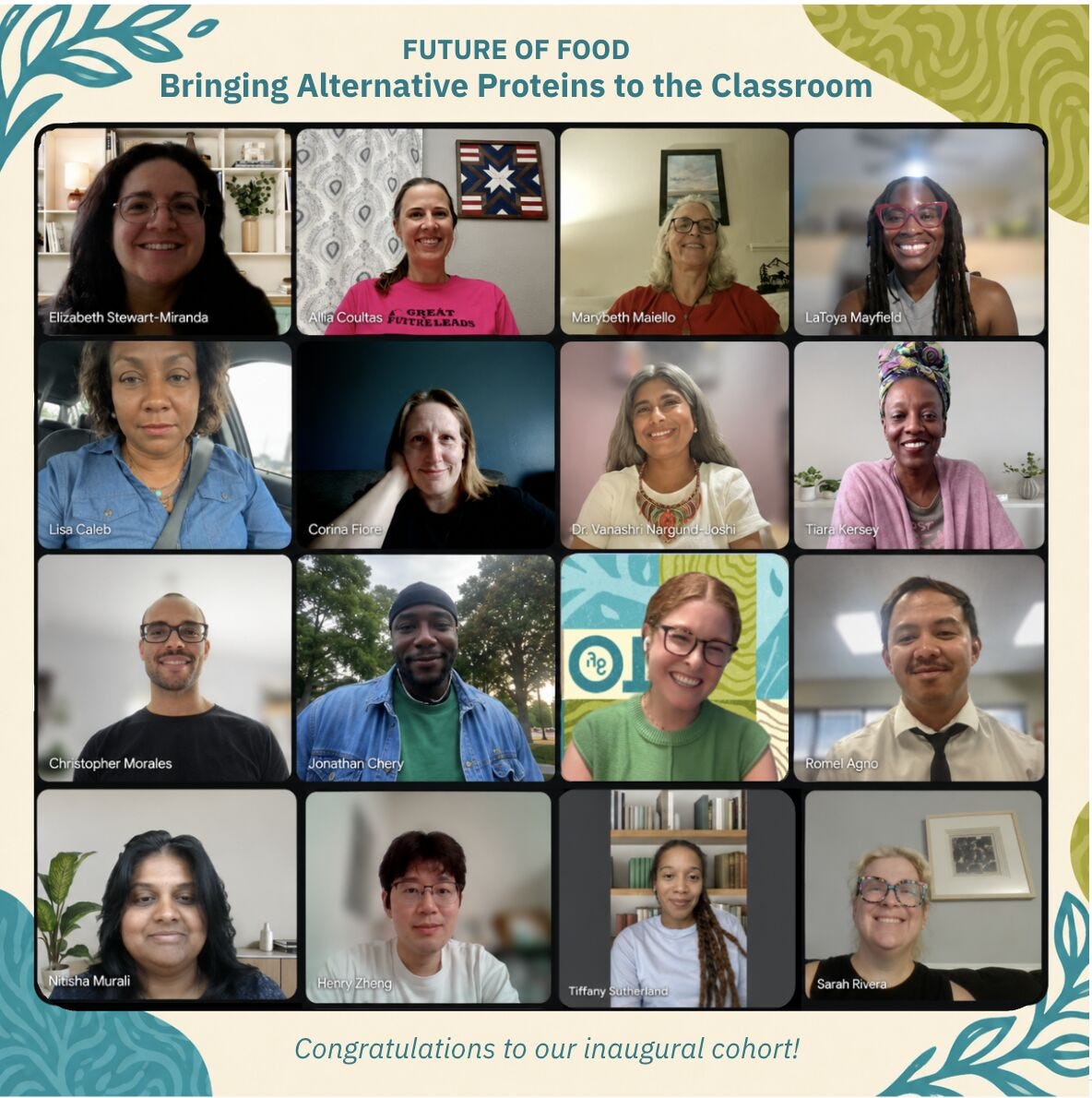
When Allia Coultas, high school science teacher from Sheridan, Wyoming, applied for GFI’s new educator program, she expected to find a few ideas she could incorporate into her Science Research class.
“I got much more than I anticipated,” she shared. “I enjoyed learning the science behind alternative proteins and getting to hear from experts in their fields. This was WAY better than typical professional development for teachers.”
Allia was one of 15 educators who completed the Future of Food: Bringing Alternative Proteins to the Classroom. Thanks to our generous donors, GFI was able to offer our first professional development program designed to help teachers bring alternative protein science to their students.
The teachers in this program spent four weeks learning about plant-based, fermentation-derived, and cultivated meat. They participated in online modules, peer discussions, and live sessions that featured insights from GFI, industry stakeholders, students, and fellow educators.
Each participant finished the program with a customized curriculum to integrate what they learned into their classroom teaching.
Connecting new science to familiar subjects
The cohort brought together educators from across the U.S. who teach biology, chemistry, environmental science, food science, culinary arts, engineering, nutrition, research, and community-based STEM programs.
One of the most exciting parts of the program is how insights can be adapted to a wide range of disciplines, allowing educators to weave alternative protein science into the lessons they already teach.
For example, one chemistry educator plans to compare aquafaba and egg foams while teaching intermolecular forces. Another computer science teacher developed an interactive tool that challenges students to design a burger within environmental, taste, and nutrition constraints. Other teachers will use alternative proteins to teach biotechnology, sustainability, data analysis, or scientific argumentation.
“I took the online course to learn about innovations in the food sciences so that I can bring that information to my students in terms of engineering and sustainability,” said Corina Fiore, a high school environmental engineering and sustainability teacher from Horsham, Pennsylvania. “This course got me thinking critically about how to bring real-world innovations into the classroom.”
Because of this training, these teachers now expect to bring alternative protein education to approximately 1,472 students during the 2026–27 school year.
Helping students see a place for themselves
Reaching students early in their educational journeys is critical. Students reflect on college, careers, and their place in science long before they enter the workforce. At the same time, these students often have little opportunity to encounter alternative proteins in school.
By educating educators on plant-based, fermentation, and cultivated protein science, we aim to help more students see how the subjects they are already learning connect to real-world food system challenges and emerging careers.
“This course has had a significant impact on me as an educator by giving me the confidence and scientific foundation to introduce alternative proteins in an evidence-based, balanced way,” said Tiffany Sutherland, a high school food science teacher from Hamilton, Ohio. “I now feel better equipped to prepare my students for the future of food while encouraging them to evaluate emerging technologies through critical thinking rather than misinformation.”
What happens next?
Ninety-three percent of participants rated the program very or extremely valuable, and every educator expressed interest in future opportunities with GFI.
The benefits will continue to grow as these educators put their plans into practice this coming school year. Through this real-world implementation, educators will reach more students, equipping future food innovators with game changing science that can help us build a more sustainable food supply.
This project’s impact demonstrates that when we equip educators with deeper knowledge and a shared belief in the power of students, we can ignite change that starts in a classroom but ripples far beyond it.
Your support can directly shape the future of food
“This course gave me a practical, up to date look at alternative protein science and clear frameworks I could actually use in my classroom. If another educator asked, I would encourage them to take it because it offers solid, relevant content that easily connects high school STEM topics to real world applications.”
— Romel Agno, high school physics teacher from Tombstone, Arizona
This project is just one piece of a larger puzzle to engage future food leaders at GFI. Through this work, we’ve already seen what happens when we equip students and educators with the resources they need: they build entire ecosystems with them.
GFI’s Alt Protein Project, a student-led movement to build a more sustainable food supply, shows how students and teachers alike want practical STEM coursework to help tackle pressing global challenges.
For the alternative protein sector to scale, we need confident leaders ready to navigate the commercial landscape. And donor funding helps build the infrastructure that turns passionate educators and students into the field catalysts this sector needs.
If you want to be a part of that magic, visit gfi.org/donate.
Congratulations and best wishes to all! Thank you for your important work!